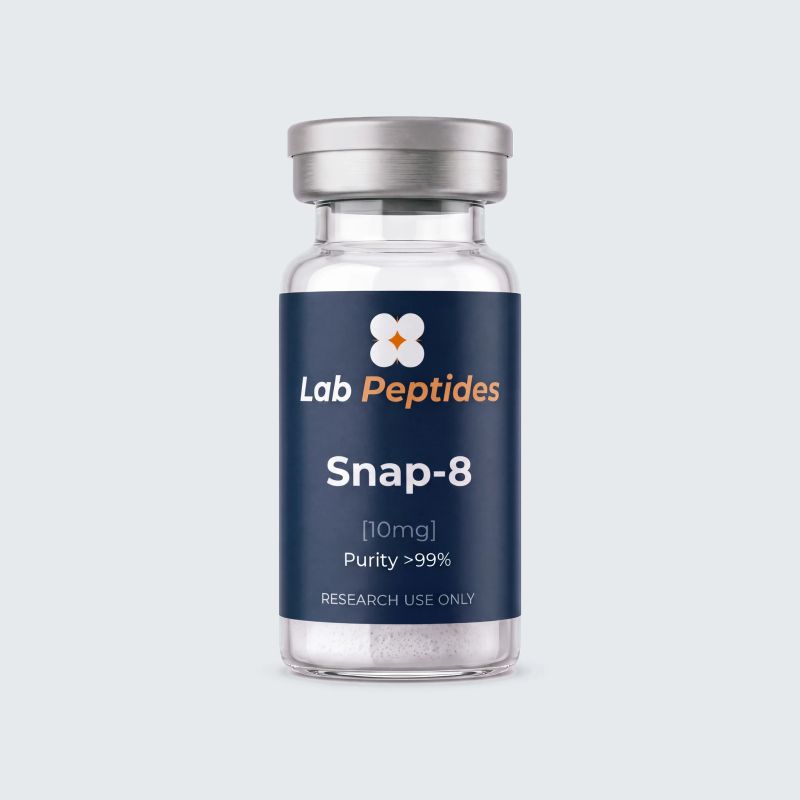
Snap-8 10mg Skin Tissues
The SNARE complex octapeptide.
Snap-8, 10 mg per vial. Acetyl octapeptide-3: eight amino acids, modelled on the end of the SNAP-25 protein. A reagent for cosmetic research. Lyophilised powder, to be reconstituted. Stocked in France. For research use only.
- In stock in France
No commitment · No auto-charge · Pause in 1 click
Your complete kit
The vial alone cannot be used as is. Add what you need to prepare it:
Research Use Only (RUO) · Prohibited for human or veterinary use.
Key facts
Snap-8 is the common name of acetyl octapeptide-3 (1075.2 g/mol): eight amino acids, Ac-Glu-Glu-Met-Gln-Arg-Arg-Ala-Asp-NH2. This vial holds 10 mg, lyophilised.
Its sequence reproduces the N-terminal end of SNAP-25, a protein of the SNARE complex. It is a reagent for cosmetic research, studied in vitro.
Stocked in France. Order the 10 mg vial and receive it with no customs clearance. For laboratory research use only.
In detail
Mechanism of action
The SNARE complex brings together three proteinsSNAP-25, syntaxin and synaptobrevin. Their assembly draws the membrane of a vesicle close to that of the cell, the step that precedes the release of the vesicle's contents.
Snap-8 reproduces a fragment of SNAP-25. In vitro work studies its competition with the whole protein for a place in the complex. Acetylation of the N-terminal end and amidation of the C-terminal end are two common modifications of synthetic peptides.
Protocol and preparation
| Water added | Concentration | Reading marker |
|---|---|---|
| 1 ml | 10 mg/ml | 10 UI = 1 mg |
| 2 ml | 5 mg/ml | 40 UI = 2 mg |
The volume of water does not change the product, only its concentration. Introduce the water slowly along the vial wall, never directly onto the lyophilisate, then swirl without shaking. Markers given on a 1 ml syringe graduated in 100 units.
Asepsis
Disinfect surfaces and stoppers (70% alcohol).
Solvent
Draw the required volume of bacteriostatic water.
Introduction
Inject gently against the vial wall (avoid direct jet on powder).
Solubilization
Roll the vial gently. Do not shake vigorously (degradation risk).
Solution storage Once reconstituted: 2-8°C (refrigerator).
Warning Theoretical tool for chemical handling. Does not constitute medical advice.
Open the dilution calculator- The amount of powder looks tiny. A lyophilisate takes up a few millimetres at the bottom of the vial, sometimes just a translucent film. The stated weight is there.
- The powder is compact, stuck to the wall or to the stopper. Transport moves the freeze-dried cake around. It changes nothing to reconstitution.
- The vial carries no individual label. That is our standard packaging, not a downgraded vial.
- After reconstitution, deposits or filaments appear. This is common, especially with small molecules. Let it settle and roll the vial between your palms, never shake it.
- The parcel is plain. Nothing on the outside indicates the contents or the brand name.
What is not normal: a cracked vial, an uncrimped cap or a stopper that moves, powder that has liquefied or changed colour. In those specific cases, write to us with a photo and we take the vial back.
Data and studies
Technical data
- Peptide sequence
- Ac-Glu-Glu-Met-Gln-Arg-Arg-Ala-Asp-NH2
- Molecular formula
- C41H70N16O16S
- Molecular weight
- 1075.2 g/mol
- CAS number
- 868844-74-0
- Physical form
- Poudre lyophilisée blanche
- Recommended solubility
- Eau bactériostatique, NaCl 0.9%, acide acétique 0.1%
- Storage conditions
- Au réfrigérateur (+2 à +8 °C), à l'abri de la lumière. En poudre, possible au congélateur pour une conservation longue. Une fois préparé : réfrigérateur, jamais au congélateur.
- Use
- Research reagent, in vitro only (RUO)
Studies and references
Snap-8 extends by two residues acetyl hexapeptide-8, described by Blanes-Mira et al. (International Journal of Cosmetic Science, 2002). That publication remains the academic reference for the family; for the octapeptide itself, most of the documentation comes from its original manufacturer.
Available data are in vitro work and cosmetic studies. The product sold here is a reagent, for research only.
Storage & handling
Unreconstituted vial. In the refrigerator, between +2 and +8 °C, away from light. The freezer (-20 °C) suits long-term storage.
After reconstitution. In the refrigerator only, away from light, never in the freezer.