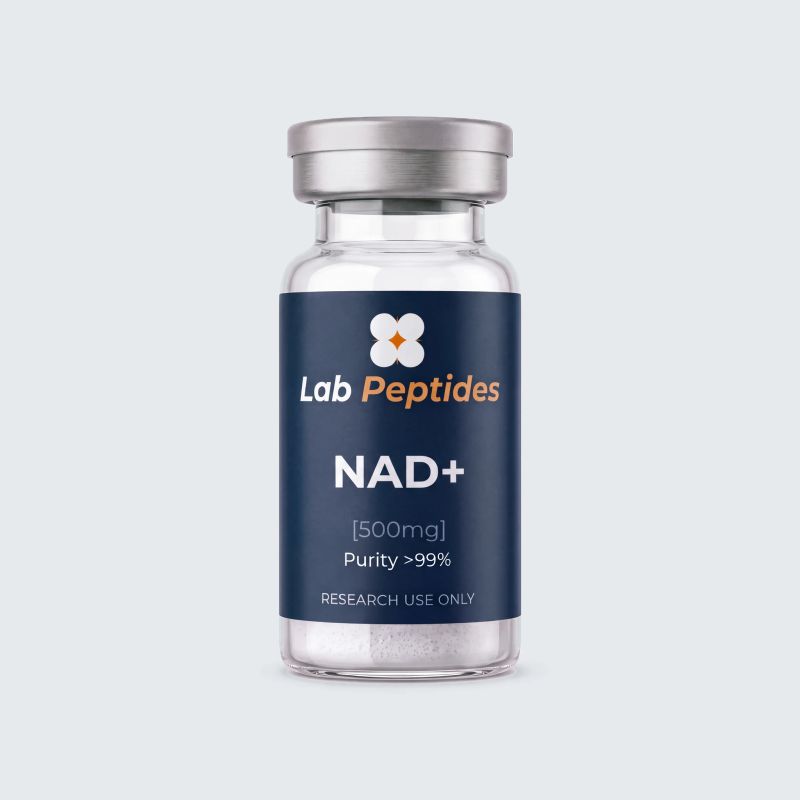
NAD+ 500mg Cellular senescence
The coenzyme, 500 mg. Tested at 99.9%.
- Certificate of analysis
- In stock in France
No commitment · No auto-charge · Pause in 1 click
Research Use Only (RUO) · Prohibited for human or veterinary use.
Key facts
NAD+ (Nicotinamide Adenine Dinucleotide, MW 663.43 Da) is not strictly a peptide: it is a dinucleotide coenzyme present in every living cell, the obligatory catalyst of more than 500 enzymatic reactions linking energy metabolism, DNA repair, calcium signalling and epigenetics. It is also one of the best-documented biological markers of ageing: intracellular NAD+ levels drop by roughly 50 % between ages 20 and 60 in human tissues, and this erosion correlates directly with loss of mitochondrial function, insulin resistance, cognitive decline and frailty in older subjects.
In detail
This vial delivers 500 mg of high-purity NAD+ (>98 %, HPLC), type I glass, fluorinated butyl stopper, inert seal. Lyophilisation protects the molecule from hydrolysis: as anhydrous solid at -20 C, stability exceeds 24 months. After reconstitution in bacteriostatic water, the solution remains usable for 14 days refrigerated at 4-8 C, provided warming-cooling cycles and light exposure are minimised. In accordance with European regulations, this product is intended exclusively for in vitro research and preclinical studies on non-human models: it is neither a medicinal product, a food supplement, nor a medical device.
Data and studies
Technical data
- Reconstitution
- 2,5 ml d'eau → 200 mg/ml.
- Molecular formula
- C21H27N7O14P2
- Molecular weight
- 663.4 g/mol
- CAS number
- 53-84-9
- Physical form
- Poudre lyophilisée
- Recommended solubility
- Eau bactériostatique, NaCl 0,9%
- Storage conditions
- Au réfrigérateur (+2 à +8 °C), à l'abri de la lumière. En poudre, possible au congélateur pour une conservation longue. Une fois préparé : réfrigérateur, jamais au congélateur.
- Use
- Research reagent, in vitro only (RUO)
Storage & handling
Sealed unreconstituted vialStorage in the fridge (+2 to +8 °C); a -20 °C freezer is an option for long-term storage (over 3 months). At room temperature (20-25 C), do not store beyond 30 days; beyond, NAD+ oxidation to ADP-ribose accelerates.
- 4-8 C (standard laboratory refrigerator): optimal stability 14 days, acceptable up to 21 days if the vial has not been repeatedly taken out and returned.
- -20 C (freezing): NOT RECOMMENDED for NAD+ in solution. Unlike short peptides, NAD+ is a dinucleotide sensitive to freeze-thaw cycles, which cause crystallisation and partial hydrolysis.
- Light: keep protected from light in an opaque box or wrapped in aluminium. NAD+ absorbs in UV (maximum 260 nm) and degrades under prolonged UV exposure.
- pH: the reconstituted solution has a natural pH around 5.5-7.5. Avoid any contact with strongly alkaline solutions (pH >9), which accelerate pyrophosphate bond hydrolysis.
- Colour: shift from pale yellow to amber brown = advanced oxidation.
- Opacity or precipitate: formation of insoluble aggregates = structural degradation.
- Odour: appearance of ammonia smell = release of free nicotinamide (hydrolysis).
If in doubt, discard the vial. The cost of a reconstituted vial is negligible compared to research time lost on data corrupted by degraded product. Rigorously document reconstitution date, lot, draws performed and storage conditions in a laboratory logbook.