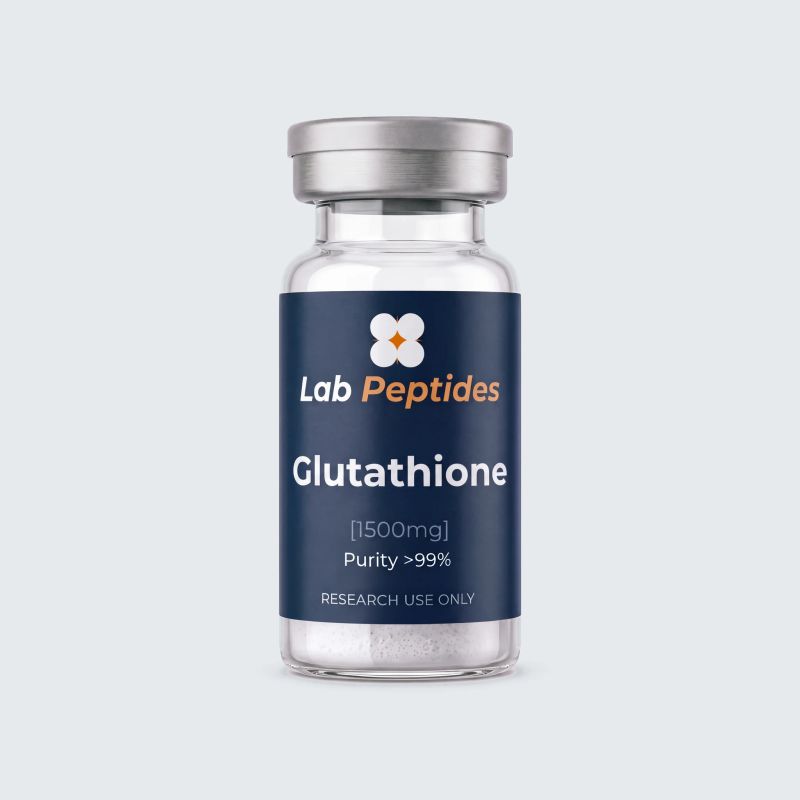
Glutathione 1500mg Extracellular matrix
The thiol tripeptide, 1,500 mg vial.
- In stock in France
No commitment · No auto-charge · Pause in 1 click
Research Use Only (RUO) · Prohibited for human or veterinary use.
Key facts
Glutathione 1500mg (GSH, reduced L-glutathione) is the master antioxidant tripeptide of the living cell, with the sequence gamma-Glu-Cys-Gly. Its structural feature is unique among peptides: the gamma bond, formed via the glutamate side chain, makes it resistant to classical peptidases and explains its biological stability. With a molecular weight of 307 Da and the formula C10H17N3O6S, glutathione is present in every cell at millimolar concentrations, where it forms the first line of defense against oxidative stress.
Data and studies
Technical data
- Reconstitution
- 7,5 ml d'eau → 200 mg/ml.
- Peptide sequence
- γ-Glu-Cys-Gly
- Molecular formula
- C10H17N3O6S
- Molecular weight
- 307.33 g/mol
- CAS number
- 70-18-8
- Physical form
- Poudre lyophilisée blanche
- Recommended solubility
- Eau bactériostatique, NaCl 0.9%, acide acétique 0.1%
- Storage conditions
- Au réfrigérateur (+2 à +8 °C), à l'abri de la lumière. En poudre, possible au congélateur pour une conservation longue. Une fois préparé : réfrigérateur, jamais au congélateur.
- Use
- Research reagent, in vitro only (RUO)
Storage & handling
In lyophilized form, Glutathione 1500mg is stable when stored in the fridge (+2 to +8 °C), away from light and air; a -20 °C freezer is an option for long-term storage (over 3 months). The dry powder withstands room-temperature transport over a few days, but since glutathione is oxidation-sensitive, cold storage on receipt is recommended to preserve the maximum reduced form (GSH).
After reconstitution, glutathione is markedly more fragile than most peptides: the solution must be kept at +2/+8°C, away from light, and used quickly (ideally within a few days). Prolonged contact with atmospheric oxygen progressively converts GSH into inactive GSSG. Reseal tightly, minimize the dead air volume in the vial, and avoid any freeze/thaw cycle.
Our peptides are HPLC-tested to over 98% purity and vacuum lyophilized.