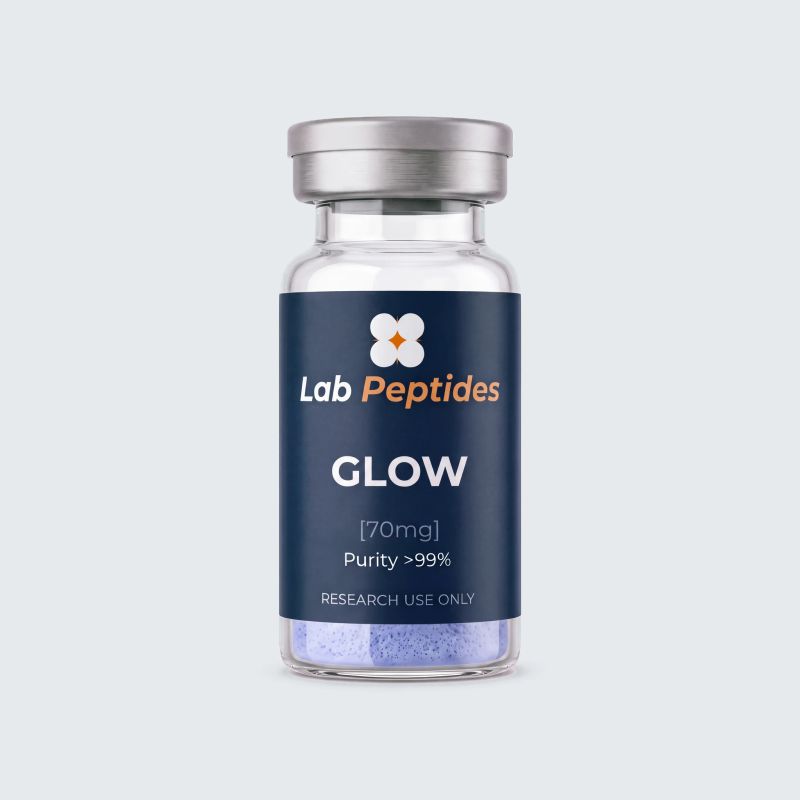
Glow 70mg Extracellular matrix
Three peptides, one vial. 99.4% purity.
- Certificate of analysis
- In stock in France
No commitment · No auto-charge · Pause in 1 click
This product contains BPC-157 et TB-500. Published work covers angiogenesis, the formation of new blood vessels. No randomised human clinical trial has characterised contraindications.
The theoretical alerts described in preclinical work concern a history of cancer, particularly vascularised solid tumours, pregnancy and breastfeeding, and proliferative retinopathies.
Research Use Only (RUO) · Prohibited for human or veterinary use.
Key facts
GLOW 70 mg is a lyophilized combination formulation bringing together the three peptides most documented in cosmetic and regenerative research applied to skin and hair: GHK-Cu (50 mg), BPC-157 (10 mg), and TB-500 (10 mg). Each component targets a distinct biological lever of cutaneous tissue remodeling, and their combination covers the full cascade observed in preclinical dermal regeneration: extracellular matrix remodeling, local microvascular perfusion, and migration of resolving cell populations.
In detail
The logic behind this blend is not cosmetic marketingIt rests on an observation reproduced across more than forty years of peptide literature. Cutaneous renewal of injured, aged, or stressed tissue never mobilizes a single mechanism but an ordered sequence — controlled degradation of the old ECM, vascular recruitment to deliver nutrients and cells, repopulation by competent keratinocytes and fibroblasts, and synthesis of well-organized new collagen and elastin. No isolated peptide covers this complete sequence. GHK-Cu dominates matrix remodeling and transcriptomic modulation; BPC-157 specifically targets angiogenesis via the VEGF-R2/eNOS axis; TB-500 mobilizes migration of fibroblasts, keratinocytes, and endothelial cells toward remodeling zones. These three axes are additive, documented, and non-redundant.
Data and studies
Technical data
- Reconstitution
- 3 ml d'eau → 23,3 mg/ml.
- Peptide sequence
- Mélange : GHK-Cu (prézatide de cuivre) (50 mg) + BPC-157 (10 mg) + TB-500 (thymosine β4) (10 mg)
- Physical form
- Poudre lyophilisée bleutée
- Recommended solubility
- Eau bactériostatique, NaCl 0,9%
- Storage conditions
- Au réfrigérateur (+2 à +8 °C), à l'abri de la lumière. En poudre, possible au congélateur pour une conservation longue. Une fois préparé : réfrigérateur, jamais au congélateur.
- Use
- Research reagent, in vitro only (RUO)
Storage & handling
GLOW is a tri-peptide blend combining a copper-peptide complex (GHK-Cu), a gastric pentadecapeptide (BPC-157), and a thymic fragment (TB-500). Each of these components has its own stability requirements, and the blend's behavior in solution reflects the most fragile compound.
Unopened lyophilized powder. Storage in the fridge (+2 to +8 °C) in the original packaging, protected from direct light: documented stability 12-18 months. For storage beyond 3 months, a -20 °C freezer remains an option, with documented stability of 24 months. At controlled room temperature (15-25 degrees), stability limited to 3-6 months, with progressive degradation observable via discoloration of the lyophilized cake (shift from normal bluish tint to a greenish-brown in case of copper complex loss).
Reconstituted vial. Refrigerated storage only 2-8 degrees, in its packaging or an opaque container. Practical stability 14-21 days, limited mainly by the BPC-157 component (less stable in solution than GHK-Cu, which benefits from stabilization by the copper complex). TB-500 is relatively stable in solution (10-14 days comfortably). The weak point of the blend in solution is therefore BPC-157: beyond 21 days, the relative proportion of peptides shifts (degraded BPC-157, still-active GHK-Cu and TB-500) and the blend loses its pharmacological balance.
Visual degradation signs. The freshly reconstituted solution presents a very-pale-blue to pale blue-green coloration, due to the GHK-Cu complex. This coloration is the main visual marker of integrity. Warning signs: color shifting to brown or dark greenish (copper oxidation or release of the cupric ion), appearance of particles or turbidity (peptide precipitation or contamination), total loss of coloration (copper release in free solution, denatured complex). In all these cases, discard the vial.
Light protection. The GHK-Cu complex is modestly photosensitive: keep the vial in its cardboard sleeve or an aluminum pouch. UV radiation can dissociate the copper complex. For long storage, aluminum packaging or a refrigerator with an opaque door is preferable.
Freeze-thaw cycles. The lyophilized powder tolerates several out-and-back cold cycles without significant degradation, provided each cycle remains short (less than 30 minutes at room temperature) and the powder does not take up moisture. The reconstituted solution must NEVER be frozen: freezing significantly degrades all three peptides and can dissociate the GHK-Cu copper complex.
Transport. Upon shipping, the vial typically travels at ambient temperature 48-72 hours, with no documented impact on lyophilized powder stability. If the parcel arrives with an abnormally colored cake (greenish, brown, or totally white without any bluish tint), photograph and contact the laboratory before reconstitution.
Practical "split vial" tip. For a researcher planning to use the blend over more than 3 weeks, it may be preferable to split reconstitution in two: reconstitute half the vial in 1.5 ml of bacteriostatic water, use over 2 weeks, then reconstitute the other half. This however requires an initial aliquoted cake, rarely provided by default. In practice, reconstitute entirely in 3 ml and strictly respect the 14-21 day window.